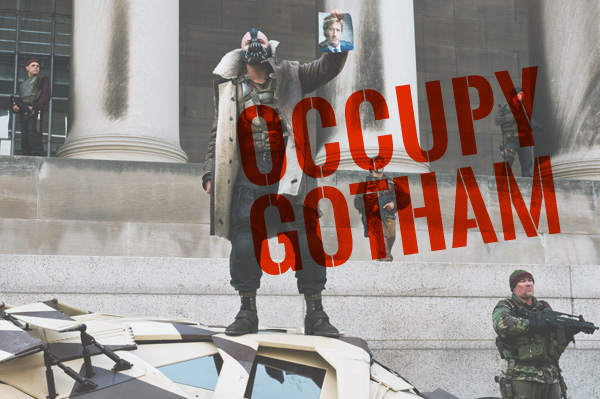
Slovenian Philosopher, cultural critic, and overall public intellectual Slavoj Žižek has written an excellent piece considering Christopher Nolan’s Batman films as political metaphors, focusing in particular on the civic uprising led by Bane in The Dark Knight Rises . In the essay “Dictatorship of the Proletariat” Zizek compares Bane’s motives and ideology to those of Harvey Dent / Two-Face, the Joker, and even Batman himself.
Back to Nolan, the triad of Batman-films thus follows an immanent logic. In Batman Begins , the hero remains within the constraints of a liberal order: the system can be defended with morally acceptable methods. The Dark Knight is effectively a new version of the two John Ford western classics ( Fort Apache and The Man Who Shot Liberty Valance ) which deploy how, in order to civilize the Wild West, one has to “print the legend” and ignore the truth – in short, how our civilization has to be grounded onto a Lie: one has to break the rules in order to defend the system. Or, to put it in another way, in Batman Begins , the hero is simply a classic figure of the urban vigilante who punishes the criminals where police cannot do it; the problem is that police, the official law-enforcement agency, relates ambiguously to Batman’s help: while admitting its efficiency, it nonetheless perceive Batman as a threat to its monopoly on power and a testimony of its own inefficiency. However, Batman’s transgression is here purely formal, it resides in acting on behalf of the law without being legitimized to do it: in his acts, he never violates the law. The Dark Knight changes these coordinates: Batman’s true rival is not Joker, his opponent, but Harvey Dent, the “white knight,” the aggressive new district attorney, a kind of official vigilante whose fanatical battle against crime leads him into killing innocent people and destroys him. It is as if Dent is the reply of the legal order to Batman’s threat: against Batman’s vigilante struggle, the system generates its own illegal excess, its own vigilante, much more violent than Batman, directly violating the law. There is thus a poetic justice in the fact that, when Bruce plans to publicly reveal his identity as Batman, Dent jumps in and instead names himself as Batman – he is “more Batman than Batman himself,” actualizing the temptation Batman was still able to resist. So when, at the film’s end, Batman takes upon himself the crimes committed by Dent to save the reputation of the popular hero who embodies hope for ordinary people, his self-effacing act contains a grain of truth: Batman in a way returns the favor to Dent. His act is a gesture of symbolic exchange: first Dent takes upon himself the identity of Batman, then Wayne – the real Batman – takes upon himself Dent’s crimes.
Finally, The Dark Knight Rises pushes things even further: is Bane not Dent brought to extreme, to its self-negation? Dent who draws the conclusion that the system itself is unjust, so that in order to effectively fight injustice one has to turn directly against the system and destroy it? And, as part of the same move, Dent who loses last inhibitions and is ready to use all murderous brutality to achieve this goal? The rise of such a figure changes the entire constellation: for all participants, Batman included, morality is relativized, it becomes a matter of convenience, something determined by circumstances: it’s open class warfare, everything is permitted to defend the system when we are dealing not just with mad gangsters but with a popular uprising.
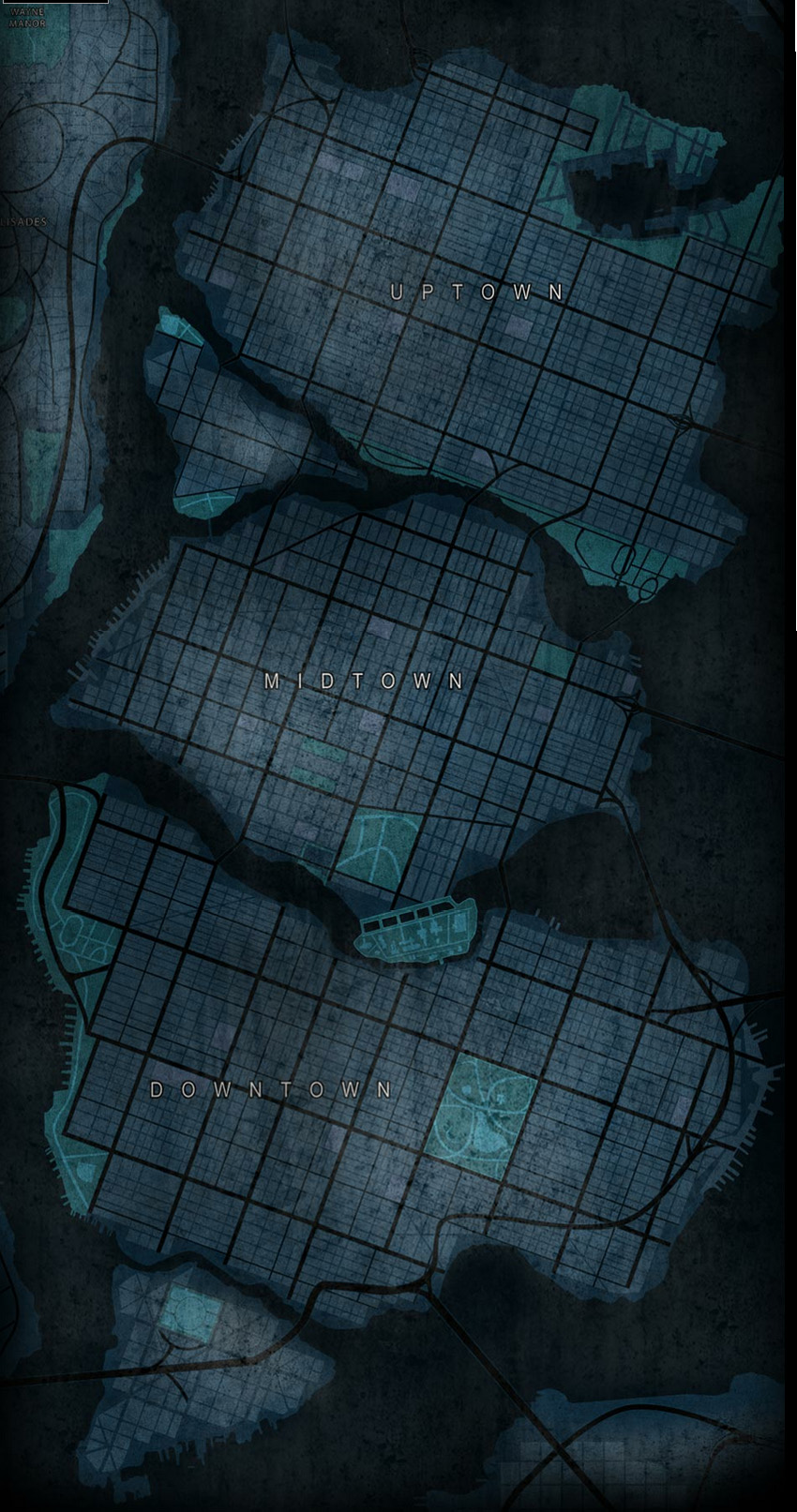
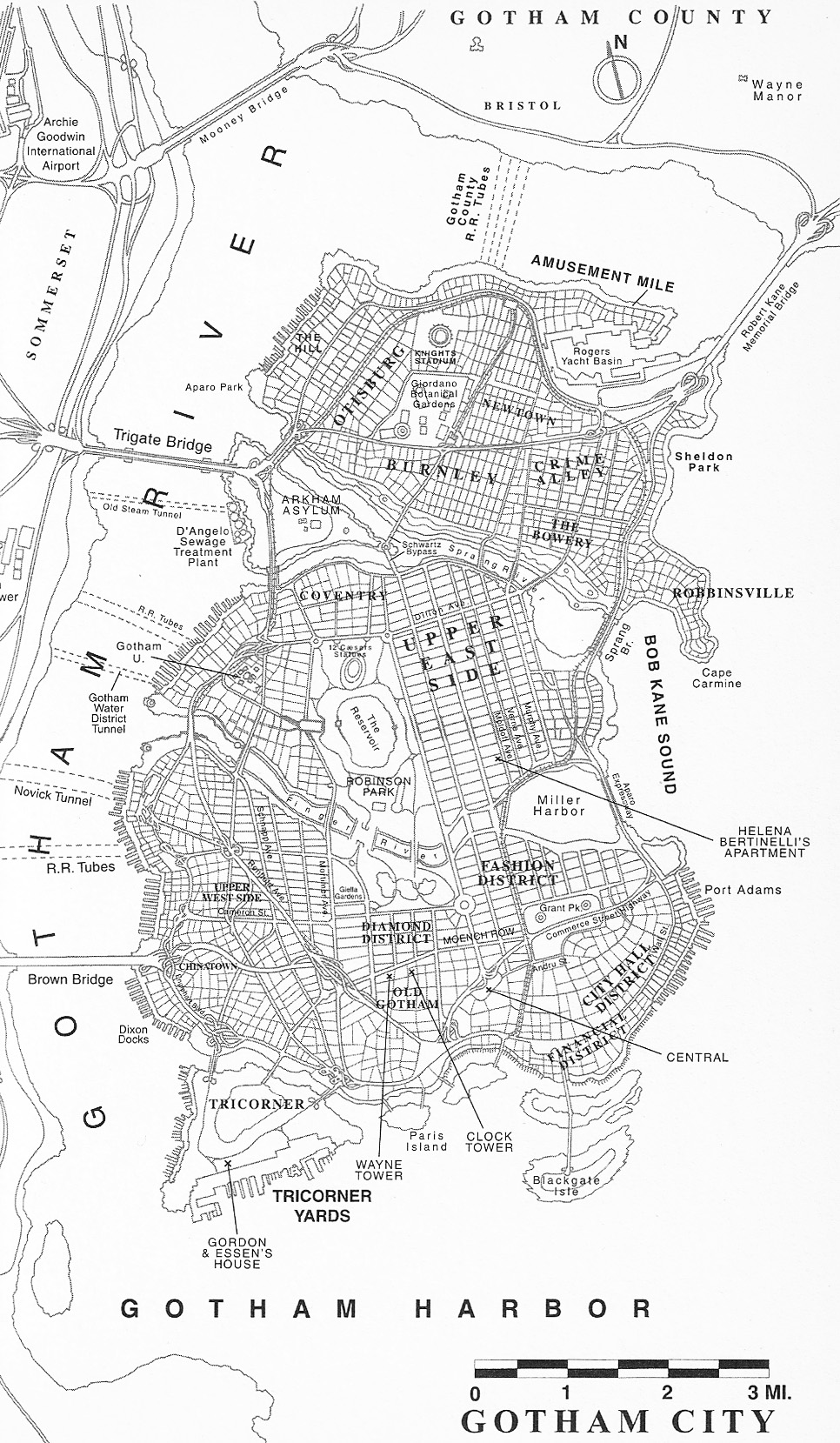
This Gotham City Map was taken from a The Dark Knight Rises viral marketing campaign game, The Fire Rises , that asks players to join Bane’s gang in their request to take over Gotham. The Map confirms that the Gotham City of Christopher Nolan’s Batman films follows a very similar cartographic design to the Gotham City map established in the comic books by Eliot R. Brown during the No Man’s Land arc.
see also:
Gotham City Map Archive
Since it’s inception, Gotham City has been presented as the embodiment of the urban fears that gave rise to the American suburbs, the safe havens from the city that they are. Gotham City has always been a dark place, full of steam and rats and crime. A city of graveyards and gargoyles; alleys and asylums. Gotham is a nightmare, a distorted metropolis that corrupts the souls of good men. In the excellent book,
Woody Allen on Woody Allen


With his psychological origins linked to the rampant criminal behavior of Gotham, Batman is inarguably a product, an expression, of the city he lives in. But is he its demon or its savior? The duality of Batman’s effect on Gotham has been frequently debated in comics, and recently in the Nolan Batman films. Despite his noble intentions, it’s entirely possible that Batman is in fact one of the major causes of Gotham’s problems. In dressing up as a bat, he may have succeeded in instilling a primal sense of fear into the citizens of Gotham, but he’s also inadvertently inspired a new breed of criminal. Through his actions, through his very existence, he has directly influenced the rise of some of the city’s “super-villains.” Batman Begins makes this threat all too real in the final conversation between Jim Gordon and Batman:
Jim Gordon: What about escalation?
Batman: Escalation?
Jim Gordon: We start carrying semi-automatics, they buy automatics. We start wearing Kevlar, they buy armor-piercing rounds.
Batman: And?
Jim Gordon: And *you’re* wearing a mask and jumping off rooftops…
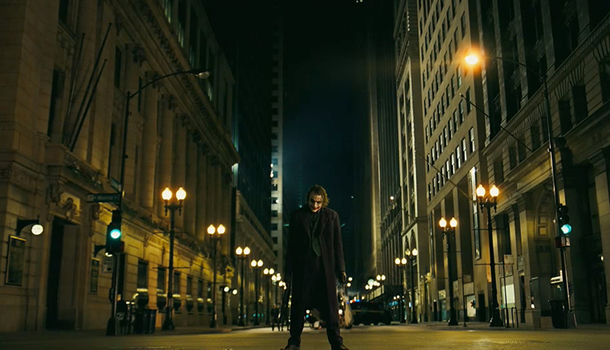
In The Dark Knight , the Joker is constantly likening himself to Batman, showing that there may be an all-too-thin line between the criminally insane and the supposedly heroic; a duality expressed literally in the good-guy-turned-bad Harvey “Two Face” Dent and in a series of conversations between the Joker and Batman.
The Joker: Oh, you. You just couldn’t let me go, could you? This is what happens when an unstoppable force meets an immovable object. You are truly incorruptible, aren’t you? Huh? You won’t kill me out of some misplaced sense of self-righteousness. And I won’t kill you because you’re just too much fun. I think you and I are destined to do this forever.
Batman: You’ll be in a padded cell forever.
The Joker: Maybe we can share one.
and later
Batman: Then why do you want to kill me?
The Joker: [laughs] I don’t want to kill you! What would I do without you? Go back to ripping off mob dealers? No, no, NO! No. You… you… complete me.
Batman: You’re garbage who kills for money.
The Joker: Don’t talk like one of them. You’re not! Even if you’d like to be. To them, you’re just a freak…like me!
To the Joker, and probably to many people in Gotham, Batman is just the opposite side of the same coin.
[parts of this post were excerpted from On Influence: Batman and Gotham City ]
]]>

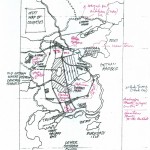
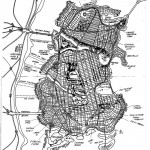
Gotham City limits were defined in 1998. While the city as we think of it today can be said to have its origins in the early 19th century, it wasn’t until the dawn of the 21st that it was charted. The first official map of Gotham was created in preparation for the “No Man’s Land” story arc, in which the city was nearly destroyed by a massive earthquake. The narrative required a lot of logistics and an understanding of the city, so DC Comics gave illustrator Eliot R. Brown was given the task to design modern Gotham.
The DC Comics editors made it clear that Gotham City was an idealized version of Manhattan. Like most comic book constructs, it had to do a lot of things. It needed sophistication and a seamy side. A business district and fine residences. Entertainment, meat packing, garment district, docks and their dockside business. In short all of Manhattan and Brooklyn stuffed into a … well, a nice page layout.
Here is the glorious final result, as seen in the novelization of
Batman: No Man’s Land

The story is a compelling read and gives a lot of insight into the thought process behind creating Gotham, as well as the world of DC comics in the 1990s.
Via out The Story Behind DC Comics’ Famous Gotham City Map .
Eight years after Batman took the fall for Two Face’s crimes, a new terrorist leader emerges to lead an assault on Gotham City and the Dark Knight must resurface to protect a city that has branded him an enemy.
]]>